About 10-15% of cases of kidney cancer develop venous tumour thrombus (VTT), an unusual phenomenon where the tumour invades out of the kidney into the major vessels of the abdomen, potentially threatening the liver and heart. For these patients, curative surgery is extensive and risky. In 2022, the NAXIVA trial, led by Professor Grant Stewart, showed that using eight weeks of axitinib, a tablet that targets tumours’ blood supply, can reduce the size of kidney cancers invading the vena cava making surgery safer and easier (Stewart et al. British Journal of Cancer 2022).
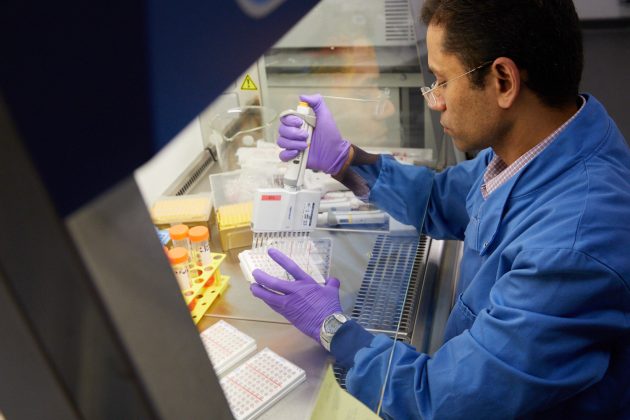
In this translational work, Dr James Jones and colleagues analysed tumour and blood samples from patients in the NAXIVA trial. They found that patients who had high densities of blood vessels in the tumour tended to respond better to treatment with axitinib, whereas patients with high levels of immune activation in the blood did not respond as well.
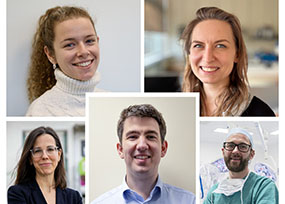
Using machine learning, Rebecca Wray and Dr Hania Paverd, researchers in Dr Mireia Crispin-Ortuzar’s group at the Early Cancer Institute, modelled which factors are driving the response in each patient and found that a small number of key blood markers can predict patients’ outcomes at the start of treatment. The levels of placental growth factor, a key signalling factor for blood vessel development, increased significantly in the blood stream early on treatment. This could be used as an early indicator of treatment response. Adding in more blood results after a short period of treatment improved the ability to predict outcome.
Joint first author, Rebecca Wray said, ‘Understanding why some kidney cancer patients with venous tumour thrombus respond to treatment while others do not is crucial for improving care. Our study uses AI to uncover distinct biological features that predict response to neoadjuvant axitinib, bringing us closer to more effective, personalised treatment strategies.’
This work demonstrates how translational work is a vital part of clinical trials. Dr James Jones, Translational Lead at the UMVI said, ‘This study is important because it shows understanding the biology of blood vessels and immune cells in kidney tumours can help us to predict patient response to treatment before surgery. Using machine learning can allow us to gain even more understanding of the results from clinical trials.’