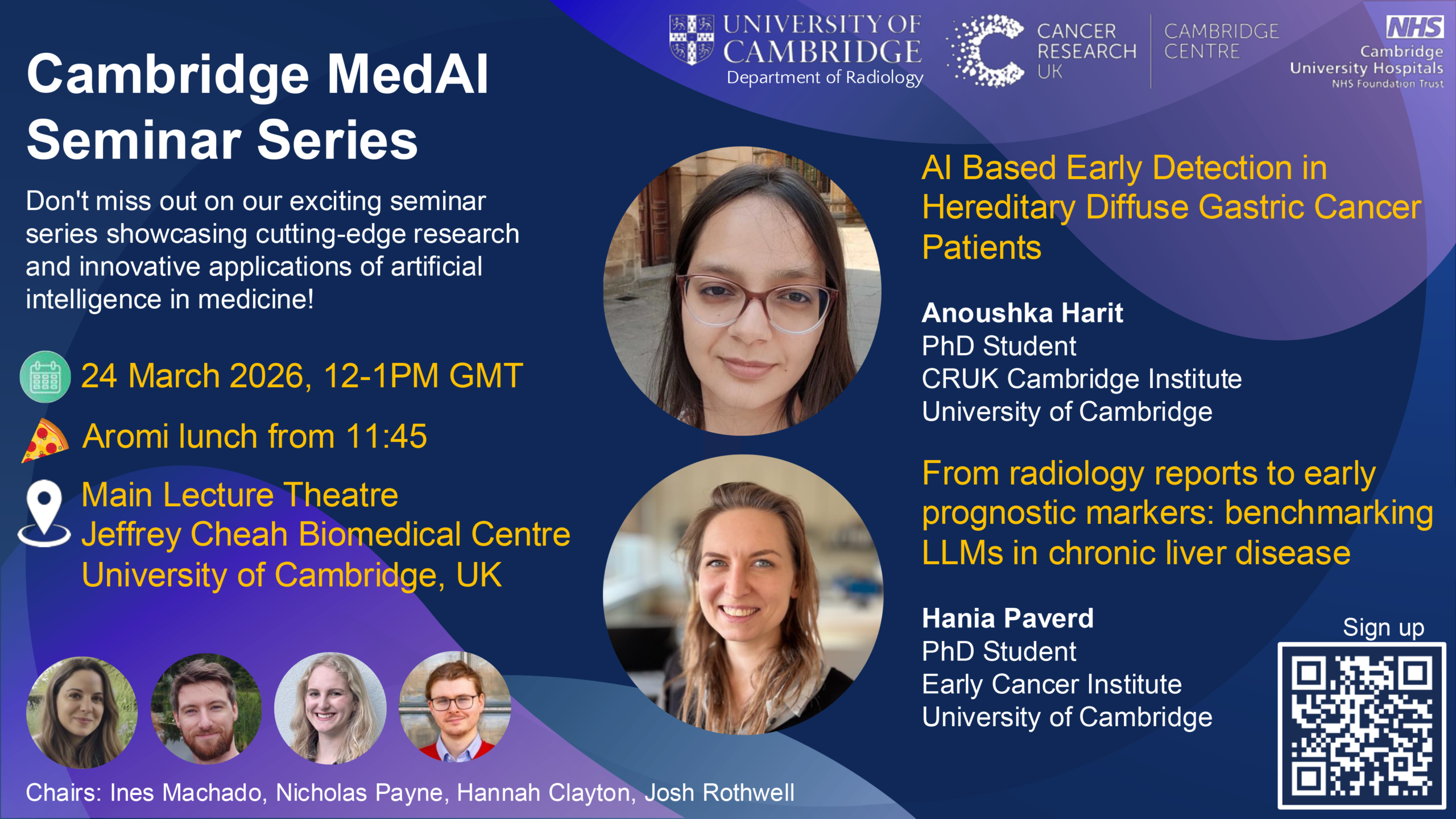
This month’s seminar will be held on Tuesday 24 March 2026, 12-1pm at the Jeffrey Cheah Biomedical Centre (Main Lecture Theatre), University of Cambridge and streamed online via Zoom.
A light lunch from Aromi will be served from 11:45.
This is the Eventbrite link to sign up.
The event will feature the following talks:
AI Based Early Detection in Hereditary Diffuse Gastric Cancer Patients – Anoushka Harit, PhD Student, Cancer Research UK Cambridge Institute, University of Cambridge
Anoushka Harit is a researcher working at the intersection of artificial intelligence, machine learning, and biomedical imaging. Her work focuses on developing computational approaches to improve early detection of gastrointestinal cancers, particularly hereditary diffuse gastric cancer (HDGC). She previously completed an MSc in Computer Science at Durham University, where her research focused on optimisation strategies for neural networks. Her broader research interests include machine learning, graph-based learning methods, and explainable AI, with a focus on applying these methods to clinical imaging and healthcare applications.
Abstract: Hereditary Diffuse Gastric Cancer (HDGC) is a genetic cancer predisposition syndrome most commonly associated with germline mutations in the CDH1 gene and characterised by the development of early signet ring cell carcinoma (SRCC). Detecting early SRCC lesions during endoscopic surveillance is particularly challenging because these lesions often appear as subtle pale mucosal abnormalities that are difficult to distinguish from normal mucosa. In this work, we investigate an AI-assisted approach for identifying and characterising pale mucosal regions in endoscopic images using colour, texture, and morphological features. Using annotated endoscopic frames, we developed a computational framework to distinguish SRCC lesions from normal pale mucosa.
From radiology reports to early prognostic markers: benchmarking LLMs in chronic liver disease – Dr Hania Paverd, PhD Student, Early Cancer Institute, University of Cambridge
Hania is a third-year PhD student at the Early Cancer Institute, working under the supervision of Mireia Crispin and Matt Hoare. Her research focuses on applying computational techniques to advance the early detection of liver cancer. Hania has a medical background, having studied medicine at Newnham College, and she is a radiology resident at Addenbrooke’s Hospital.
Abstract: Large scale research on real-world clinical data is fundamentally limited by free-text format of clinical documentation, with vital prognostic clues remaining trapped within vast, unstructured medical narratives. In Hepatocellular carcinoma (HCC), this data bottleneck often results in late-stage diagnoses despite regular patient surveillance. To unlock these latent insights and shift toward proactive risk stratification, we developed a scalable, LLM-driven pipeline capable of transforming free-text clinical reports into quantitative variables and longitudinal disease timelines. By benchmarking open-source large language models, we found Llama 3.3 70B outperformed smaller and medically fine-tuned models to achieve ≥90% accuracy across 59 of 73 extraction tasks, allowing us to reliably map disease progression. Deploying this automated framework across more than 22,000 heterogeneous records from an 835-patient liver transplant cohort, we successfully surfaced key HCC risk factors and validated routine clinical metrics at an unprecedented scale. Ultimately, this work establishes a new paradigm for research on real-world clinical data, showcasing that advanced AI can reliably reconstruct clinical histories to power large-scale research and hopefully enable earlier, data-driven interventions.