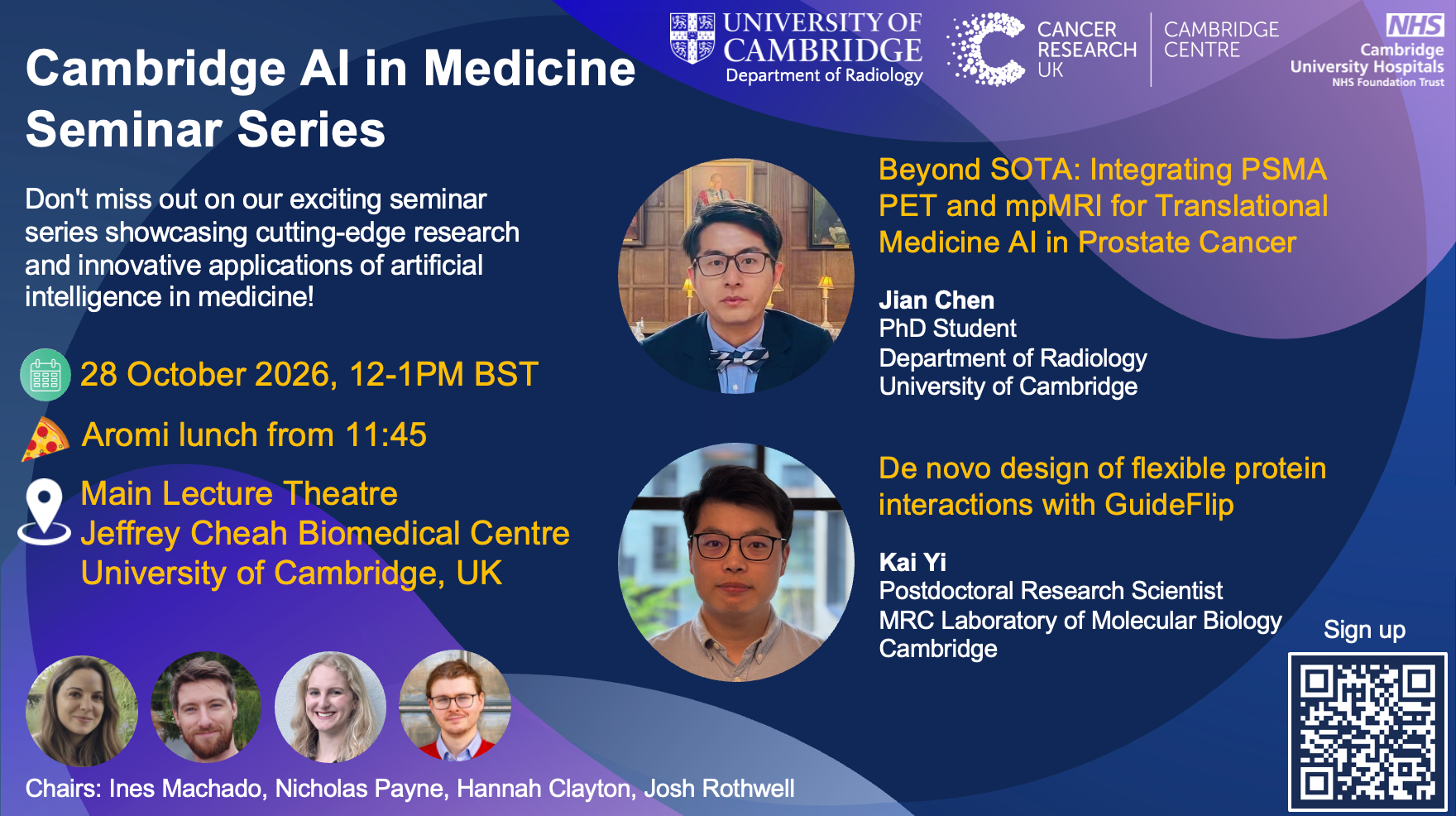
This month’s seminar will be held on Wednesday 28 October 2026, 12-1pm at the Jeffrey Cheah Biomedical Centre (Main Lecture Theatre), University of Cambridge and streamed online via Zoom. A light lunch from Aromi will be served from 11:45. The event will feature the following talks:
Beyond SOTA: Integrating PSMA PET and mpMRI for Translational Medicine AI in Prostate Cancer – Jian Chen, PhD Student, Department of Radiology, School of Clinical Medicine, University of Cambridge
Jian Chen is a PhD researcher at the University of Cambridge, focusing on artificial intelligence for translational medicine. His research spans multimodal learning and large-scale clinical data analysis, integrating cardiovascular imaging (CTA, CMR, CT perfusion and ECG), oncological imaging (CT, MRI and PET), and multi-omics data. His research has contributed to publications in journals including European Heart Journal – Cardiovascular Imaging, BMC Medicine, IEEE Transactions on Medical Imaging, npj Digital Medicine, and Cell Reports Medicine.
Abstract: Integrating complementary information from multiple imaging modalities offers new opportunities for AI-driven cancer diagnosis and clinical decision-making. In this talk, I will introduce our recent work published in npj Digital Medicine, exploring multimodal fusion of PSMA PET/CT and multiparametric MRI for clinically significant prostate cancer detection, with a focus on methodological innovation, multicentre validation, and clinical translation.
De novo design of flexible protein interactions with GuideFlip – Kai Yi, Postdoctoral Research Scientist, MRC Laboratory of Molecular Biology, Cambridge
Kai Yi is a Postdoctoral Research Scientist at the MRC Laboratory of Molecular Biology in Cambridge. He received his Ph.D. in Mathematics and Statistics from UNSW. His research combines generative AI, geometric deep learning and structural biology to develop computational methods for designing proteins and understanding biological systems. His work spans de novo protein and antibody design, with applications to neurodegenerative diseases and challenging membrane-protein targets. He has published at leading AI conferences, including NeurIPS, ICML, ICLR and CVPR.
Abstract: De novo design of protein binders typically requires a target structure. However, for flexible targets, such as intrinsically disordered proteins, this structure may not exist until a binder stabilizes the interaction. Such targets are therefore challenging for methods that separate structure generation from sequence design. We introduce GuideFlip, which co-designs structure and sequence through guided discrete flow matching: binder residues are assigned progressively while the complex is re-predicted at each step, allowing the evolving interface to guide the design process. GuideFlip reduces the hydrophobic bias of direct AlphaFold optimization and improves in silico success rates over existing approaches. We release a database of binder candidates for 177 human disordered proteins. Experimentally, we obtain de novo binders to the carboxy terminus of α-synuclein and the disordered amino terminus of RBX1, with hit rates of 13.5% and 41.7%, respectively, and confirm the epitopes of selected binders by NMR and mutagenesis. Extending GuideFlip to flexibility on the binder side, we achieve a 75% hit rate in a nanobody design campaign and identify a nanobody that binds the agonist-bound β1-adrenergic receptor in its active state, but not the receptor in its inactive state, with a cryo-EM structure confirming the design. GuideFlip enables protein design where bound structures emerge only upon binding.
Eventbrite link: https://medai-oct2026.eventbrite.co.uk