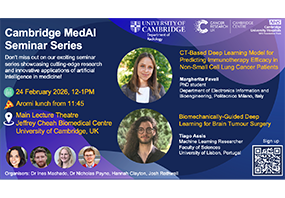
This month’s seminar will be held on Tuesday 24 February 2026, 12-1pm at the Jeffrey Cheah Biomedical Centre (Main Lecture Theatre), University of Cambridge and streamed online via Zoom.
A light lunch from Aromi will be served from 11:45.
This is the Eventbrite link to sign up.
The event will feature the following talks:
CT-Based Deep Learning Model for Predicting Immunotherapy Efficacy in Non-Small Cell Lung Cancer Patients – Margherita Favali, PhD student, Department of Electronics Information and Bioengineering, Politecnico Milano, Italy
Margherita Favali is a PhD student in Bioengineering at Politecnico di Milano. She is currently working on the I3Lung project, focusing on developing Artificial Intelligence models to predict Immunotherapy response in NSCLC patients using CT scans, with an emphasis on applying explainability techniques to make these models transparent and understandable.
Abstract: Non-small cell lung cancer (NSCLC) accounts for the majority of all lung cancers and, despite advances in systemic therapies, prognosis remains poor. Immunotherapy (IO) has transformed the treatment landscape for advanced NSCLC; however, outcome heterogeneity persists, underscoring the need for reliable tools for early risk stratification. While deep learning models show promising results, trustworthy clinical deployment requires evaluation beyond performance, incorporating fairness and explainability. This work presents a structured framework for the trustworthy assessment of medical imaging models applied to six-month overall survival (OS6) prediction in IO-treated NSCLC patients. Using 483 patients with baseline CT scans from the APOLLO11 observational study, we used a 2D ResNet50 architecture pretrained on RadImageNet, and systematically analyze the impact of oversampling, undersampling, and class-weighted loss on performance. We evaluate model along three dimensions: (1) predictive performance, (2) equalised-odds fairness across sex- and age-sensitive attributes, and (3) explainability with Grad-CAM, assessed quantitatively through randomization and perturbation-based faithfulness tests. The 2D ResNet50 trained with class-weighted loss achieved AUC equal to 0.68 and satisfied fairness criteria across subgroups under the equalized odds metric. Explainability analysis showed modest but meaningful faithfulness.
Biomechanically-Guided Deep Learning for Brain Tumour Surgery – Tiago Assis, Machine Learning Researcher, Faculty of Sciences, University of Lisbon, Portugal
Tiago Assis is a Machine Learning Researcher and holds an MSc in Data Science from the Faculty of Sciences, University of Lisbon, where he specialized in deep learning for medical imaging. His research centers on data-driven methods for image-guided surgery and multimodal continual learning under missing data and distribution shift. He recently shared his work at MICCAI 2025 in South Korea, where he combined biomechanical brain modeling with deep neural networks to achieve physically consistent brain shift compensation for image-guided neurosurgery. Prior to transitioning into medical AI, Tiago completed a BSc in Biochemistry at NOVA University Lisbon and worked as a lab tech in Clinical Pathology.
Abstract: Brain shift remains a major limitation in image-guided neurosurgery, reducing the accuracy of neuronavigation as resection progresses. While biomechanical models can compensate for this deformation, their computational cost limits intraoperative use. Keypoint-based registration methods offer faster alternatives but rely on geometric interpolators that can produce physically unrealistic outputs. This talk presents a deep learning framework for brain shift compensation that achieves biomechanical accuracy at clinical inference speeds. We constructed a large-scale dataset of patient-specific brain deformations using biomechanical simulations, then trained a deep neural network to generate physically plausible deformation fields from sparse intraoperative data. By supervising the network with these simulations, we implicitly encode constitutive properties of brain tissue biomechanics into its learned representations. Our experiments demonstrate that this work provides a practical compromise between physical fidelity and computational efficiency for intraoperative brain shift compensation.