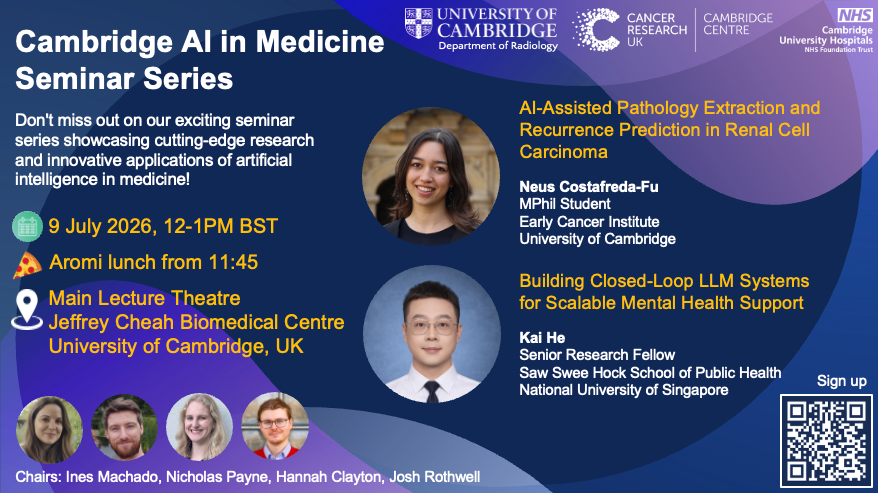
This month’s seminar will be held on Thursday 9 July 2026, 12-1pm at the Jeffrey Cheah Biomedical Centre (Main Lecture Theatre), University of Cambridge and streamed online via Zoom.
A light lunch from Aromi will be served from 11:45.
This is the Eventbrite link to sign up.
The event will feature the following talks:
AI-Assisted Pathology Extraction and Recurrence Prediction in Renal Cell Carcinoma – Neus Costafreda-Fu, MPhil Student, Early Cancer Institute, University of Cambridge
Neus is an MPhil student at the Early Cancer Institute, supervised by James Jones and Inês Machado. She studies Medicine at the University of Bristol and is undertaking the MPhil as an intercalated research degree. Her project focuses on applying artificial intelligence to kidney cancer, particularly automated extraction of structured data from pathology reports and post-nephrectomy recurrence prediction using the ARTIST study dataset.
Abstract: Routine pathology reports contain prognostic information essential for renal cell carcinoma (RCC) surveillance and adjuvant treatment decisions, but many key variables remain locked in free text. We developed an AI-assisted pipeline using data from the ARTIST study (REC 20/EE/0200) to structure RCC pathology reports and support recurrence prediction after nephrectomy. Open-source large language models were benchmarked across 537 pathology reports, covering 42 extraction tasks and 22,554 annotated fields, including tumour size, pathological stage, grade, necrosis, margin status, nodal status, histological subtype and adverse morphological features. Extracted variables from a subset of 300 clear-cell RCC patients were then used for downstream recurrence prediction, comparing machine-learning risk estimates with established clinicopathological risk stratification. Overall, the results demonstrate the feasibility of an end-to-end AI-assisted framework in which large language models convert routine free-text pathology reports into a structured dataset, and downstream machine-learning models use the extracted features to generate individualised recurrence risk estimates, supporting more personalised post-nephrectomy surveillance and treatment planning.
Building Closed-Loop LLM Systems for Scalable Mental Health Support – Kai He, Senior Research Fellow, Saw Swee Hock School of Public Health, National University of Singapore
Dr He Kai earned his PhD from the School of Computer Science and Technology, Xi’an Jiaotong University, under the supervision of Prof. Li Chen (recipient of China’s Young Thousand Talents Award), and completed a research visit at Nanyang Technological University with Prof. Erik Cambria (IEEE Fellow). He is currently a postdoctoral researcher at the National University of Singapore, School of Public Health, specializing in medical artificial intelligence and natural language processing (NLP). His work includes two ESI Highly Cited Papers, and a Best Paper Award in IEEE Transactions on Affective Computing. At present, He serves as AE for IEEE Transactions on Affective Computing and Health Data Science.
Abstract: Mental health systems worldwide are under growing strain, with increasing demand for early support and limited specialist capacity. While large language models (LLMs) have shown promise in conversational mental health applications, most existing systems operate as static chatbots without structured assessment, longitudinal monitoring, or calibrated escalation mechanisms. This talk presents a closed-loop LLM framework designed to support scalable mental health care rather than isolated conversational assistance. The system integrates empathetic dialogue generation with continuous state assessment, structured rubric-based evaluation, and reinforcement-driven improvement. A multi-agent architecture enables iterative feedback between support generation and risk evaluation, forming a dynamic loop that mirrors stepped-care principles in public health.