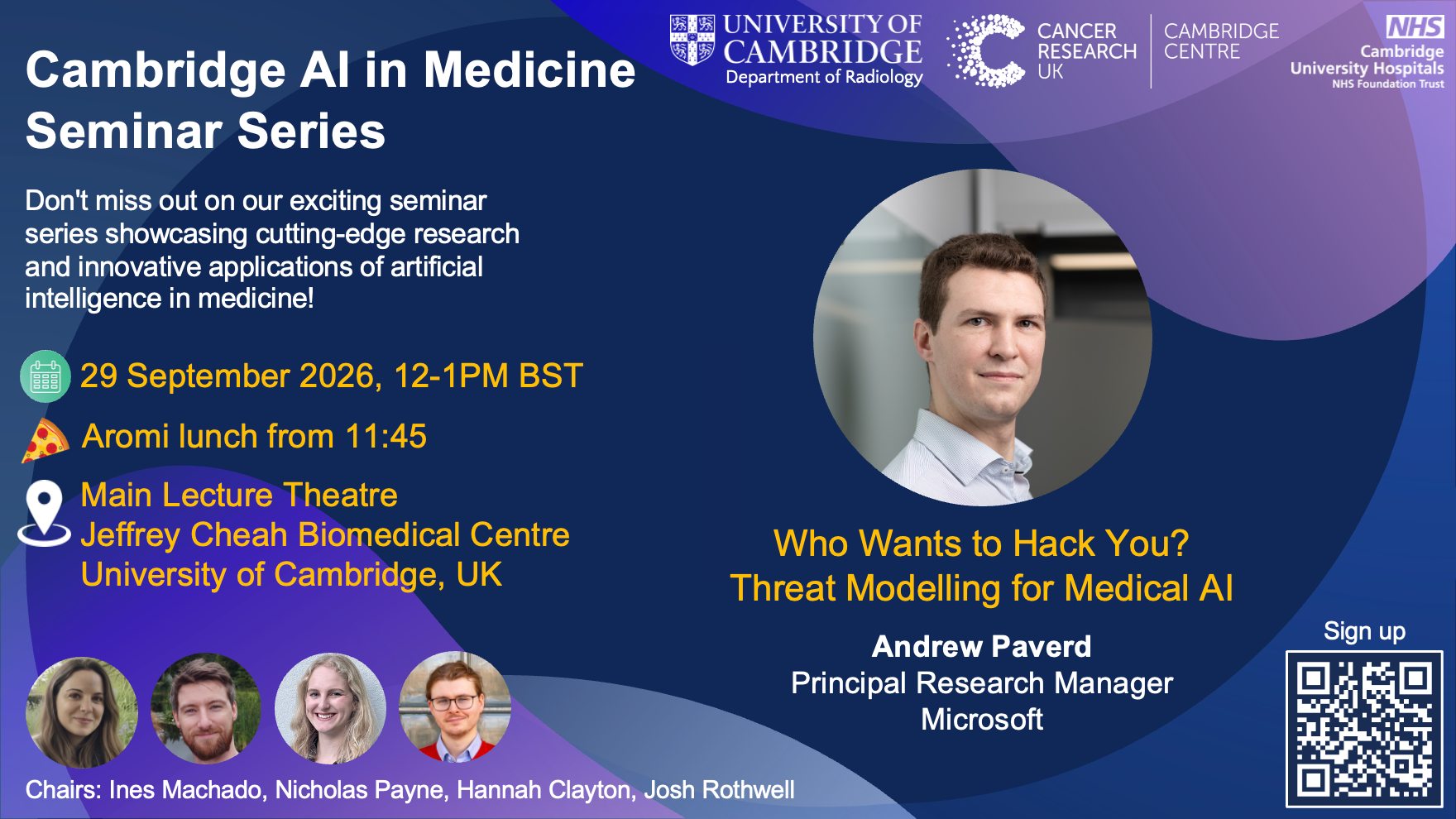
This month’s seminar will be held on Tuesday 29 September 2026, 12-1pm at the Jeffrey Cheah Biomedical Centre (Main Lecture Theatre), University of Cambridge and streamed online via Zoom. A light lunch from Aromi will be served from 11:45. The event will feature the following talk:
Who Wants to Hack You? Threat Modelling for Medical AI – Andrew Paverd, Principal Research Manager, Microsoft
Andrew Paverd is a Principal Research Manager at the Microsoft Security Response Center (MSRC) in Cambridge, where he leads vulnerability response and research at the intersection of AI and systems security. He obtained his DPhil in Computer Science from the University of Oxford. Prior to joining Microsoft, he was a Research Fellow at Aalto University in Finland and a Fulbright Cyber Security Scholar at the University of California, Irvine.
Abstract:
We all know that cybersecurity is important, particularly in healthcare and biomedical research, and we have no shortage of policies, guidelines, and training courses on how to stay “secure”. But secure against whom?
Who is the adversary? What do they want, and what are they capable of doing? These questions form the basis of threat modelling — a core technique in securing systems against real-world adversaries. From spies to criminals, from insiders to the “swamp”, this talk will explore the different categories of adversaries and their various motivating factors. Drawing on reported incidents, we’ll show how adversary objectives interact with clinical workflows and infrastructure. We’ll also discuss the cybersecurity implications of AI in medical applications, and how this changes the threat model.
Eventbrite link: https://medai-sep2026.eventbrite.co.uk