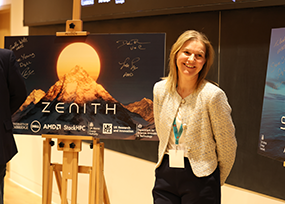
Dr Sarah Burge speaks to the Cambridge Independent and BBC Radio Cambridgeshire (2:46:20) about how the Cambridge Zenith AI Supercomputer will help cancer research and deliver on the ambition of the Cambridge Cancer Research Hospital.
Recently created through funding from the Department for Science, Industry and Technology (DSIT), Zenith is the UK’s largest AI-for-science platform, designed to deliver AI-driven breakthroughs in areas including healthcare.
Launched at an event attended by Minister for Digital Government at DSIT, James Frith MP alongside more than 80 innovators, industry leaders and academics, Zenith is hosted by the University of Cambridge and increases Cambridge’s supercomputing power six-fold, placing the city at the forefront of AI innovation in the UK.
Applying this scale of computing power to healthcare has the potential to produce AI tools that could be used across the NHS to help improve cancer diagnosis, treatment selection, outcomes prediction, and licensed for use in new therapeutics development.
Sarah stated “Zenith represents a significant step-up in our ability to improve healthcare through AI. In Cambridge, we will have the computing speed and power needed to make AI relevant to care at the scale of the NHS. It can help us to learn from the lived experiences of millions of patients to improve detection, diagnosis and treatment for the future. It won’t just shape how we treat patients but will help inform how we plan and deliver care. I am hopeful that patients at Cambridge University Hospitals will be some of the first to benefit thanks to our close connections between discovery research and NHS care.”
Sarah also highlighted Cambridge’s existing strength in AI for healthcare. The Cambridge Cancer Research Hospital, due to open in 2029, aims to develop AI-assisted clinical decision support that can inform treatment decisions in real time at the point of care. Delivering on that ambition requires computational infrastructure at a scale the NHS does not currently have access to. Zenith will allow the Hospital to deliver the clinical insights that multimodal datasets and AI make possible, and to ensure the benefits reach patients across the whole NHS and beyond.
Also in attendance was University of Cambridge Vice-Chancellor, Professor Deborah Prentice. She said “Zenith, alongside Sunrise and SAIL, transforms what the University of Cambridge can achieve. By bringing together world leading researchers with national scale AI computing power, Cambridge is now equipped to tackle some of the most complex challenges of our time, from cancer, to climate, to clean energy and turn discovery into real world impact.”
Parliamentary Under-Secretary of State, DSIT and Cabinet Office, James Frith said, “The launch of Zenith marks a major step forward in the UK’s mission to harness AI for science. By bringing together world‑class compute, research and industry expertise, we will unlock new discoveries in health, clean energy and the environment strengthening Britain’s position as a global leader in AI innovation.”
Find out more about Sarah’s thoughts on care at the Cambridge Cancer Research Hospital in her thought leadership article: Bridging the gap between innovation and care in the fight against cancer
Read the full article on the University of Cambridge website
Read the full CUH NHS Foundation Trust article