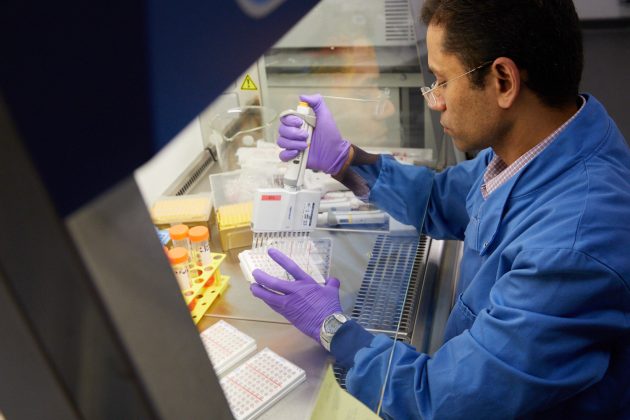
A simple and accurate blood test could improve diagnosis and aid treatment monitoring for all patients with malignant germ cell tumours (GCTs), one of the most common cancers in adults under age 40 years.
Around 2,500 people in the UK are diagnosed with GCTs each year, most of which are testicular cancers. The location of tumours for these cancers can vary widely and include the lower abdomen, chest and brain. Existing diagnostic tests require biopsies which are invasive and can be risky. There are no reliable blood tests routinely available which pick up all these malignant tumours.
This new test is a simple blood test that looks for short pieces of genetic information known as microRNAs (miRNAs), that occur in uniquely high levels in malignant GCTs.
A Cancer Research UK-funded trial (OTIS-S) is also ongoing to see whether the test could also replace the CT scans currently used to monitor patients for signs of cancer recurrence after surgery.
The test has been developed by a team led by Matthew Murray, Professor of Cellular and Molecular Pathology, University of Cambridge, an Honorary Consultant Paediatric Oncologist at Cambridge University Hospitals NHS Foundation Trust, and Co-Lead of the Children, Teenager and Young Adults Cancers programme at the Cancer Research UK Cambridge Centre.
Professor Murray said “It has been a long journey for this exciting circulating cancer biomarker from our initial discovery in Cambridge back in 2009/2010, through many developments and refinements over more than 15 years to make it even more accurate. I am very pleased that with the wider Cambridge team, the assay is now on the cusp of clinical implementation through adoption in the clinically accredited CMDL.”
He added: “The test has the ability to transform the management of patients with malignant germ cell tumours, including those with testis cancer, one of the most common tumour types in young adult men. We look forward to it being routinely available to clinicians.”
Professor Murray was the first to show that certain miRNAs are found at very high levels in the blood of all patients with malignant GCTs (including children and adults) and that levels fall in line with response to treatment.
The method he developed for miRNA detection has been widely used in research of these cancers and his team are using them in multiple clinical trials, including OTIS-S, to help diagnose patients and monitor their response to surgery/treatment.
Working alongside international research groups the Cambridge team, including Dr Cinzia Scarpini and Professor Nicholas Coleman (Department of Pathology), showed that a single miRNA, called miR-371a-3p, is enough to reliably detect malignant GCTs.
Dr Cinzia Scarpini said “I have been working intensively on developing and refining this assay for many years to optimise assay performance. I am excited to be working in collaboration with CMDL and East Genomics, to help make this test available to patients through the NHS.”
To prepare for clinical testing, the team is working with the Cancer Molecular Diagnostics Laboratory (CMDL) to help deliver the test with the scale and precision necessary for clinical use. Led by Dr Shubha Anand, the CMDL is an ISO 15189 accredited medical laboratory which facilitates translational research and clinical trials.
Dr Shubha Anand said “One of CMDL’s key goals is to translate promising research assays into clinically accredited tests. In collaboration with colleagues in the University Department of Pathology, including Dr Scarpini and Professor Murray, we are validating and optimising this assay for inclusion in CMDL’s ISO 15189 extension to scope and subsequent NHS implementation through East Genomics.”
Dr Sarah Burge, Director of Clinical Integration at the CRUK Cambridge Centre, who is facilitating the transition into the clinic, added “It takes close collaboration between research teams, our academic development labs and the Genomic Laboratory Hub to bring a research assay into routine NHS use. This work shows what that partnership can achieve, and it gives us a pathway we can use for future Cambridge discoveries, so our patients benefit from them as quickly as possible.”
To ensure the test can be done in a way that is suitable for NHS use, these efforts are being supported by NHS East Genomics, which provides genomic testing for the NHS across the East.
Dr Tom Burr, Director of Research at East Genomics, said “We are pleased to be able to support the development and implementation of this important test that will improve our ability to diagnose and treat patients whilst reducing the reliance on more invasive or costly procedures.”
With support from NHS England, the test is now being trialled at scale as part of the NHS Genomic Network of Excellence for circulating tumour biomarkers. In 2027, the team aims to submit for addition to the NHS National Genomic Test Directory, which details all genetic and genomic tests available for patients through the NHS.